FT1: The Next Step in Weak-Signal Digital?
Following the recent FT2 implementation - covered in my recent Mid Sussex ARS news article - it was probably only a matter of time before someone asked: how much further can we push weak-signal decoding?
From FT8 to FT4 and now FT2 protocols, each step in the progression has traded bandwidth, timing precision and processing power for incremental gains in sensitivity and throughput.
Enter FT1.
Positioned as the next logical evolution, FT1 builds on those foundations but introduces something new: recursive decoding enhanced by lightweight AI-assisted weighting models.
Digital Signal Processing Loops (Utilising AI)

FT1’s headline innovation is the use of Digital Signal Processing Loops (DSPLs). Rather than making a single decode attempt per transmission window, FT1 captures the probabilistic state of the received signal and recursively refines it. Each loop:
-
Re-evaluates timing offsets (per-tone Delta's)
-
Reconstructs incomplete symbols
-
Re-weights parity structures
-
Applies AI-assisted confidence scoring
-
Feeds the refined estimate back into the decoder
The embedded AI layer doesn’t 'guess' messages; instead, it dynamically adjusts statistical bias based on observed propagation behaviour, drift characteristics and noise profiles gathered over time.
The effect is cumulative. Instead of discarding frames at -28 dB, FT1 continues iterating, statistically compressing uncertainty with each pass.
In controlled tests, the results have been eye-opening: regularly reporting decodes down to -35 dB.
Designed for 24/7 Operation
Unlike FT2, FT1 is fully automated by default. It can run unattended around the clock, dynamically adjusting loop depth and decoder thresholds according to band conditions. Researchers report extremely stable medium-duration operation too.
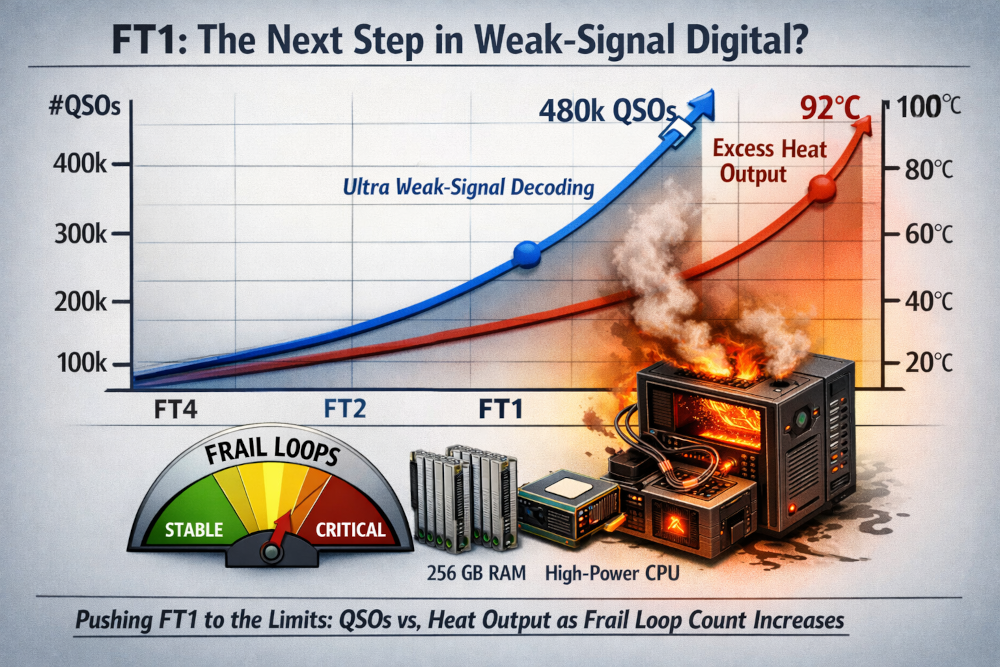
During March’s WWDigi-Xtreme contest, one experimental FT1 station reportedly logged over 480,000 contacts, easily securing first place. A significant proportion were completed at signal levels all existing decoders would simply consider unrecoverable.
Whether that represents a fundamental shift in weak-signal capability - or simply the triumph of computational muscle - is still being debated.
The Hardware Reality
There is, of course, a cost.
FT1’s recursive and AI-assisted architecture is computationally intensive. The suggested minimum compute specification includes:
-
256 GB RAM
-
2 * 128-bit Nvidia GPUs
-
Dedicated multi-core CPU resources
FT1 maintains layered probability maps across multiple loop generations, preserving statistical states rather than discarding them. However, if the system cannot sustain real-time recursion, the processing chain destabilises.
Developers refer to this rather delicately as Frail Loops - a condition in which insufficient memory bandwidth or GPU throughput causes recursion cycles to collapse, confidence weighting to drift, and performance to fall sharply back toward familiar limits.
Stable loops are essential. Frail ones, less so.
One Outstanding Limitation
There remains a practical constraint. After approximately six weeks of continuous 24/7 operation, accumulated state data begins to saturate storage and memory structures. Fragmentation increases, loop latency rises, and a controlled restart becomes necessary.
It’s not a fundamental flaw, merely an engineering refinement still in progress.
Whether FT1 proves to be the next accepted milestone in the FT8-FT4-FT2 lineage, or simply an ambitious exploration of what happens when AI meets recursive DSP, it certainly captures the imagination.
After all, progress in digital modes has always been about squeezing a little more signal from a little less noise.
Especially at this time of year.
Berni M0XYF