News
- Details
- Written by: Maintenance Guy
- Category: News
- Hits: 637
 I hope you all had fun yesterday. A big day in amateur radio here in the UK for sure. Very significant changes to our licencing conditions were waved through by Ofcom, as the proposed variations we've all been mulling-over were finally implemented.
Large nets were run to mark the occasion, with many calling in just to flaunt their increased power limits and callsign freedoms. I joined the MSARS 70cms net with the brand spanking new identifier ME0XYF/BONKERS just to see what it sounded like. It sounded worse than it looks on paper, which surprised nobody at all. It was also an excuse to give an inaugural outing to my brand new Quansheng UV-K5(8), which went down better than my new callsign.
If you were caught a little bit on the hop, then here is a catch-up of the changes now in effect, and some supplementary changes yet to follow:
Phase 1 - Changes now in effect (as of 21st February 2024)
Power increases:
- Foundation: 25 watts (most bands) - The consultation proposed 20 watts
- Intermediate: 100 watts (most bands)
- Full: 1000 watts (primary bands)
Other:
- Regional Secondary Locators ('W' Wales, 'M' Scotland, 'I' Northern Ireland, etc.) are now optional (except for Intermediate 2x)
- Those in England are now able to add an optional 'E' to their callsign at Foundation and Full (e.g. ME7XXX)
- Any suffix (after the '/' slash) is now allowed after a callsign (e.g. M7XXX/TEST01)
- New applicants will only be allowed to hold one personal licence
- Supervision of unlicensed people allowed at all 3 levels
- Airborne to be permitted to a maximum of 0.5 watts EIRP (primary bands)
- Relaxing / clarification of operating maritime (now at all licence levels)
- More flexibility for Beacons, Gateways and Repeaters (including the ability to run 5w ERP without an RSGB-issued callsign)
- More flexibility and clearer terms for remote and unattended operation
- New 'Data Station' operation clause (intended for unattended machine-to-machine modes)
- Foundation licence holders can now build their own transmitters (including kits)
- Foundation licence holders now have access to 2.4GHz and 5GHz (max 2 watts)
- If a special prefix is allowed by Ofcom (as for Queen’s Jubilee), there is no need to apply for an NoV
Ofcom will be issuing around 100,000 new licences, which will obviously take some time. The new rules come into effect today, but it may take until Autumn 2024 before all of the licences get reissued.
Phase 2 - Planned for 'Later in 2024'
- Ofcom to cease issuing 2x Intermediate calls - to be replaced with M8 and M9
- Existing Intermediates will be encouraged (but not forced) to move to M8 / M9 callsigns
- Simplified rules for Special Event (e.g. GB) callsigns
- Restrictions on the number of callsigns held (one per person for personal use, up to 5 callsigns for clubs)
Phase 3 - Planned for 'Before April 2025'
- Revoking lower-class licences begins (leaving one for personal use, and up to 5 for clubs)
- Improved online validation process
- The ability for amateurs to choose any available callsign
- The ability for amateurs to change their callsign once every 5 years
- Reissuing of old callsigns after a 5-year grace period since the licence was surrendered or revoked. This includes SK callsigns
The official Ofcom document can be downloaded below.

- Details
- Written by: Maintenance Guy
- Category: News
- Hits: 533
NOTICE is hereby given to all voting members that the 57th Annual General Meeting of the Mid Sussex Amateur Radio Society will take place as follows:
Date: 22nd March 2024 - Time: 19.45hrs.
Venue: Millfield Suite, Cyprus Hall, Cyprus Rd, Burgess Hill, West Sussex, RH15 8DX
Notice of nominations for the following Officers/Committee Members
- The Secretary
- The Program Secretary
- 1 Ordinary Member
Positions to be held for TWO years from the date of the 2024 AGM, as per the Constitution. This way it gives our Society some continuity when changing any of the Officers or Ordinary Committee Members each year when needed.
We would love you on the Committee for as many years as you feel able to serve. In our Constitution, it states that ‘Ideally nominations for committee posts to be received by the Secretary, not less than 2 weeks before the meeting.’ Therefore if you wish to record a nomination you may do so by email to the Secretary.
Please return any nominations to arrive no later than 8th March 2024. Proxy Votes may be sent to either the Secretary or your Appointee.
- Details
- Written by: Chris G4ZCS
- Category: News
- Hits: 767

Well, I have made it into another year, and started off to see what I could work during 2024.
I have not set any targets yet, but time will tell.
Thanks to Ken providing a replacement for my duff high power ATU. I have dabbled a bit on several bands using Voice, CW and data. I reset the counter for the 60m band and to date have contacted over 60 DXCCs. Last year I worked data from August to the year-end with a count of 98, and filled two logbooks.
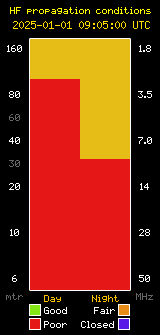
On the propagation front I have enough data to guess at least part of the mechanics of this band. Local contacts out to about 500 miles make up the bulk of contacts and are unlikely to be ground wave, more likely NVIS from my low-level dipole. Using the grid square map, I have worked just about all squares out to 1200 miles, so a second hop of NVIS or a regular F2 reflection could be the path.
I have now enough confidence to guess that the elusive DX I mentioned last year is appearing to be a form of grey-line. Usually we expect to work the sunrise/sunset track to DX stations for an hour or so. 60m seems to be different. The contacts seem only to last a couple of minutes at most and not only use the SR/SS route but also SR or SS to darkness. My daytime is generally dead for most days but as darkness falls the band opens - not only to the locals but also the DX that is already, or still, in darkness. During our late dark evenings, contacts can be made with sunrise stations to the far east and to sunset ones in the far west.
It's all very strange to me, and I hope that someone reading this can shed some light on what is really going on!

One unfortunate trait I have noticed is 'out of band' working. Here in the UK, we are strictly limited to keep within our allocated frequencies. On 60m FT8 the operating dial setting is 5.357 MHz. The upper edge of our band slot is 5.358, so, the highest audio tone we are allowed to transmit is 1 kHz (5.357 +.1 = 5.358).
Unfortunately, far too many UK calls can be seen well above this limit, having said that, when I started to use this band, I did make the same mistake and got 'shouted' at for my troubles. Ironically this was from a station that was himself too high!
At a recent ham-meet I enquired of an expert why my 60 metre contacts were not appearing in some databases? The answer is that, as yet the ARRL have not recognised this band for scoring DXCCs. Their reasoning is that there are still a number of countries that have yet to allow amateurs on this band so until then that would not represent a fair playing field!
Until next time,
73's
Chris G4ZCS
- Details
- Written by: Maintenance Guy
- Category: News
- Hits: 624
An informative and interesting evening was had by all for Phil’s talk

There was a pretty good turn out for the talk on Friday, where Phil brought along a variety of hardware to demonstrate the joys of portable use.
Questions were asked and answered as we went along with everyone having the chance to have a closer look at the tech on show at the end.
It was a lovely insight to Phil’s passion of operating all over the world with everyone hopefully going home feeling inspired to put together their own Grab 'n' Go Kit.

Finally my thanks go to Phil for taking the time and effort to do this talk and to Stella for the Tea, Biscuits and Cake enjoyed by everyone at the end.
Chris Hodgkinson (M7VJE)
MSARS Chairman.
- Details
- Written by: Chris G4ZCS
- Category: News
- Hits: 696
As we come to the end of 2023, I’ll do a quick review of my year, so this will be a bit longer than usual.
I was hoping to work 100 DXCCs as quickly as possible and preferably in January, well I did, sort of as it took till early February. This year I used a mix of CW and SSB mostly outputting 100W and up to 400 for the big pileups. As I write this, I have 115 on phone, and 156 on CW and a grand total of 194 that includes data (more later) 1 short of my all- time best of 195 in 2014 when I was still feeling OK.
January bought in a rush of stations too many to mention but Australia, Indonesia, South Africa and Greenland come to mind. In February with solar conditions improving, China, Mongolia, Bali, Nepal and most of the US and Canadian states & provinces.
By the end of March, the score had risen to 162 with the Falklands, and New Caledonia adding to the total. April, however, was a disaster in all senses, my health took a battering, so I wasn’t up to doing too much, then the antenna farm threw its toys again. This was fixed by renewing the 450 feeders with the last of my stock. Then, the computer threw a wobbly. It turns out that Windows had added a new security feature that prevented programs loading up, but with no warning or notifications. I asked for help with this and eventually identified the fault and fixed it. Since then, many dozens of others have reported the same thing but now get a 1 minute 'fix' as the procedure has been well publicised.
May, as usual, bought a load of outdoor activities like gardening (not so easy these days) and checking the antennas. The DX included VK, Hong Kong, American Samoa, and Rockall. June was equally quiet but lots of island contacts, and with Singapore, Ethiopia, and the Sovereign Military order of Malta. However, still a little way to my 200 target.
July is my month to chase islands and this year a good crop of Chinese and American ones. Another bout of side effects laid me low for a while, so I started to look into the new datamodes. With a good deal of help from Dick G0LFF I managed to get a signal out using FT8 as an experiment. I was hoping to get this running before the Autumn & winter. I found this system is a bit boring when I am feeling well, but really relaxing to use (and addictive) when I’m not feeling too good, so it’s a great help to keep me on the air.
August saw us bid farewell to Ron, G0WGP another source of wisdom and memories from WW2.
Down the garden a slight hint of hot plastic! An inspection of my weatherproof box revealed some brown colour and the smell of smoke. Checking everything revealed the balun had overheated due to dry joints on the sockets (they don’t seem to like the heat cycling out in the garden, an ongoing problem). The plastic case had to be renewed and then I found the ATU had started to play up. This limits my 15 Metres to 50W. The darker evenings bought 60 Metres to life, so I thought I’d try FT8 on this band. As I have reported in these articles this has been a great experiment to try. Some time I must do a write up of my results and thoughts on this unusual band. If anyone out there has any knowledge of the low band characteristics, I would like to hear from you.
In September I started to work some DX with FT8 on 60m and for a change I also tried 30m. This brought my first ever contact with South Dakota for worked all states. 30m behaves as one would expect propagation wise, and with the possibility of better DX, it is populated most of the day and into the evening while 60m is usually dead during our daylight hours. I think my lack of any western states is due to the fact that when the band is open here in the evening it is dead during their midday. All I need to do to get California is to stay awake till 5 in the morning!
October was great for working Europe and as I had set a target of working all Europe squares, I was filling lots of slots. At the time of writing, I have worked most of the squares out to 1,400 Km from here. The gaps are mostly sea or uninhabited! However, I still get a few new ones each week. I only now need Egypt and Syria to have all the countries on my Europe map! On the DX front 39 major squares (we are in IO) with received signals from many more including New Zealand. I guess that some of the gaps are because not all countries have the 60m allocation yet.
The end of the year bought the sad news of the passing of Mick G4EFO, another great loss to ham radio.
In the last few hours of the year 60m was still springing a few surprises with contacts with Kuwait, Monaco, Georgia, Belize, and Argentina.
So, an eventful year in spite of problems. I asked for comments last time, but I have not had any replies yet, so again, if anyone can help explain 60m propagation I would like to hear from you.
If Berni can stand it, and you want to read it, I might be able to do some more of these bits for the news next year.
[Yes please Chris, but I'm afraid I can't help you with 60m props info! Berni]
Good DXing in 2024
Chris, G4ZCS