News
- Details
- Written by: Ken Gibson
- Category: News
- Hits: 601
 Our lunchtime HF net, now on 15m, started when I contacted HO Townsend WA5MLT (later K5CX) on the 1st of September 1979. My eldest son David had just gone to Oklahoma University in Norman to take his Masters degree. I found that HO was living in Norman and he kindly offered to keep an eye on David and this led to our setting up regular skeds which enabled Stella, David’s mother to maintain a check on her 20 year old son (as mothers do).
Gradually as our regular skeds progressed, MSARS members and other amateurs joined in, and our weekend chats became a regular meeting place for US and UK participants.
Apart from HO Townsend who some of you may remember attended G5RV’s funeral as a representative of the ARRL, we had Dell Popplewell K4NBN (No Bad News) in Jacksonville, Mike Brown N4MAD in Pensacola (where I met Bob D’Imperio N4XAT who is still with us) and many others including more recently David WB1EAD in the State of Maine and Barry, SA7GDB in Sweden.
Stella and I enjoyed spending holidays with most of the US participants, many of whom in turn visited us in Cuckfield over the years to our great delight.
When I retired in 1991 the then weekend nets began to run every weekday and from a simple natter between 2 friends the net now 45 years old has continued to flourish. I have, so far filled 35 log books with my hand written records of our daily chats. That’s more than 72,000 individual entries and I hope that there are many more to come.
Age and a host of old men’s ailments have now forced me to admit that I can no longer guarantee that I will be there at 13:30 to call the net together every day and I am hoping that there will be sufficient MSARS members from now on to open the net if I am absent.
I’ll join in the lunchtime net when possible and will continue to run the Sunday morning net now on 7MHz while I can. Sean and our long term friendship is another story yet to come.
It’s been a great pleasure to run the lunchtime net for so long but nothing lasts forever and I’m sure that my absence will make no difference to the net continuing for years to come.
73 es 88 to you all,
Ken G3WYN
- Details
- Written by: Richard G0LFF
- Category: News
- Hits: 692
Lifetime member Bob N4XAT sent me a copy of his certificate for working 1000 unique reference areas on the Parks On The Air (POTA) program.

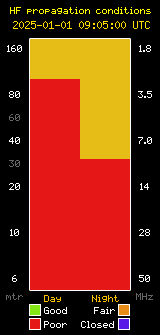
Bob is a serious CW operator and only reverts to FT8 for the stations he cannot quite get on CW. Bob logs in on the MSARS SDR for the daily lunchtime net currently on 21.350 MHz SSB +/- QRM. When conditions allow, Bob joins in - he often calls in between overs but some are too fast on the trigger on the handover. Living in a retirement park, he is limited on antennas. He uses an MFJ magloop out on the lawn as well as experimenting with stealth wires when he can. David, WB1EAD often joins the net too, having the advantage of a three element Yagi. When I am up on the Downs /M, I often QSO both with zero signal showing on my Icom IC-705 when other home-based stations do not hear them.
Dick G0LFF
- Details
- Written by: Richard G0LFF
- Category: News
- Hits: 582
Thought I would share a couple of my interesting QSL cards for contacts on SSB.
VR6TC, Tom Christian, a direct descendant of the infamous Fletcher Christian of 'Mutiny on the Bounty' fame.

4Z4DX was worked from Burgess Hill on 2M SSB at a distance of 2196 miles or 3434 Km. That is DX for sure!

HC2GE worked on 6M SSB, note his comments on the card, 1 watt into a homebrew 3 element Yagi. 5813 miles, 9355 Km, not bad for VHF. My ODX on 6M SSB is VK.

Solar Cycle 25 is already stronger than the two previous cycles so get ready for some stellar conditions on both VHF and HF as we near the peak.
Dick G0LFF
- Details
- Written by: Maintenance Guy
- Category: News
- Hits: 555
 Alan and Stella recently suffered what all of us who don't religiously backup our data dread the most, a hard-disk failure, and that has obviously meant a backlog of meeting minutes being prepared for publication on the website.
Credit to them then, that they have pushed on and generated those minutes (as well as other society documentation that they have responsibility for) and these have now duly been uploaded for our members to read.
Alan has also edited video recordings of the last two society lectures by speakers Gwyn Griffiths G3ZIL on HF noise reduction, and Geoff Budden G3WZP on the Royal Signals Museum, which will both now be uploaded to YouTube and listed in our Videos section very shortly.
I hope you enjoy consuming all this fresh material, and don't forget the last Direction Finding event of 2024 this evening!
Berni M0XYF
- Details
- Written by: Chris G4ZCS
- Category: News
- Hits: 660

At the beginning of the month there was a special activity celebrating the 13 Colonies. These were the forerunners to the states that became the USA in later times. I know several club members were chasing contacts, but I was a bit slow off the mark, however I did manage 10 stations in the end. According to QRZ.com the QSL cards are much sought after and limited in numbers, so, have a go next year?
FT8 is still throwing up surprises, new islands and new DXCCs for the year. At the end of the first week, I got a 'decode' from one of the remotest parts of the planet, Pitcairn Island. My look-up shows a total population of just 46 people. How many amateurs there are I don’t know but VP6MW’s QRZ page is well worth the read even if you have never heard of the place.
In August there will be an expedition to Jarvis Island in the Pacific (No 17 on the most wanted list.) K8R in American Samoa has been experimenting with equipment and FT8 software. I had tried without success to work them on 15 metres hearing strange signal characteristics. A quick update to the program at both ends and bingo, first attempt and 4th call got a full QSO.
This month’s picture is just one of the far-off places worked earlier in the year.

I know that some think that these new modes are not real radio, however some are game changers while others are dead-enders. I remember when PSK31 arrived and the scramble to use it, but now hardly any activity.
In the middle of the month, I worked Haiti for my darts score 'treble top' of 180! Only 20 more to get the magic 200 for the year.
This time of year is usually quiet for DX but with some expeditions there is some to work (if you can hear them.) On the FT8 front I managed at least 24 islands for IOTA and 35 of the USA 'lower 48' states. Paperwork-wise I have started claiming confirmation for historic contacts, many using ClubLog’s 'OQRS' automated system for claiming cards for matched contacts. Really useful tech.
Cheers & Good DXing
Chris, G4ZCS